Reddit's Casey Kern on the newest step in the customer journey, why it runs on trust, and why testing needs a longer window.
There is a habit most people pick up when buying something online. You search for a product, skim the results, then run the search again with one word added to the end: reddit.
That search lands in places like r/BuyItForLife, where 3.9 million people argue over whether a pair of boots will outlive its owner. Nobody in those threads is a sponsored influencer, which is exactly why people read and trust them.
Casey Kern, Director of Agency Development at Reddit, has watched the customer journey change across two decades on the agency and platform side. "This idea of validation is an entirely new concept for consumers as well as marketers," she says.
The customer journey used to run in a straight line. It has since picked up a new stop between consideration and purchase, where shoppers check their pick with people who already own the product. A plan built for the old route still reaches the shopper, but it can miss the moment a buying decision gets made.
Key takeaways
- The customer journey no longer runs in a straight line. People source ideas, research, validate, buy, rethink, and share in no fixed order.
- Validation is the new stop between consideration and purchase, where shoppers check a pick with people who already own it.
- Reddit's Path to Purchase 2026 research found US consumers name honest, first-hand experience as their deciding purchase factor twice as often as reviews from professional critics or influencers.
- Trust on Reddit runs both ways. Brands that join the conversation openly and answer back are the ones that land on the shortlist.
There’s a new stop between consideration and purchase
The customer journey has lost its conventional order. People source ideas, research, act, rethink, and share, pulling from more places than ever.
Inside that tangled web, one new behavior shows up: people start looking for someone who has already bought the same product. Casey calls that stage “validation.” Consideration narrows a list, but validation checks whether the list can even be trusted.
The trigger behind these actions is trust. Let's say a shopper asks AI about a product they're looking to buy, but has no idea where the answer came from. The model scanned what it could reach, including Reddit, and handed back one paragraph. Nothing in that paragraph says which opinions got left out or who said what.
So shoppers go looking for a trusted source, usually someone who already owns the product and posted about it. Reddit's research found US consumers name honest, real-world experience as their deciding purchase factor twice as often as reviews from professional critics or influencers. Half of US shoppers also check an AI shopping assistant's recommendation on Reddit before they buy.
Discovery now comes from everywhere, and the deciding vote sits with someone who already bought the thing and shared their thoughts.
Casey calls that "a modern-day word of mouth," the most trusted source there ever was, "doing that at scale."
Relevance stems from a two-way conversation
Most paid media works in one direction: the brand launches ad sets, the audience sees the message in a feed, and that’s where it ends.
Of course, that reach matters, but Casey calls out what optimizing solely for impressions can't do on its own. "More reach and frequency does not necessarily create relevance," Casey says. Context creates it, and on Reddit the context is a conversation the shopper can join.
Relevance is important here because it keeps working after a campaign push ends. A helpful answer in a product thread stays where the next shopper finds it, and the one after that. We see the same pattern in experiential marketing: people who interact with a brand carry it further than people who only see it. Those conversations happen with or without the brand. "Consumers are already talking about you," Casey says.
We built the Care Index around that idea, which measures how consumers actually interact with a brand (Know, Like, and Care) and ties it to the revenue that follows. Validation is where Care can get made or lost, one shopper at a time.
Show up authentically
A brand can also step into that room. Sonos did just that after the consumer audio electronics company changed a product feature and the r/Sonos community objected loudly.
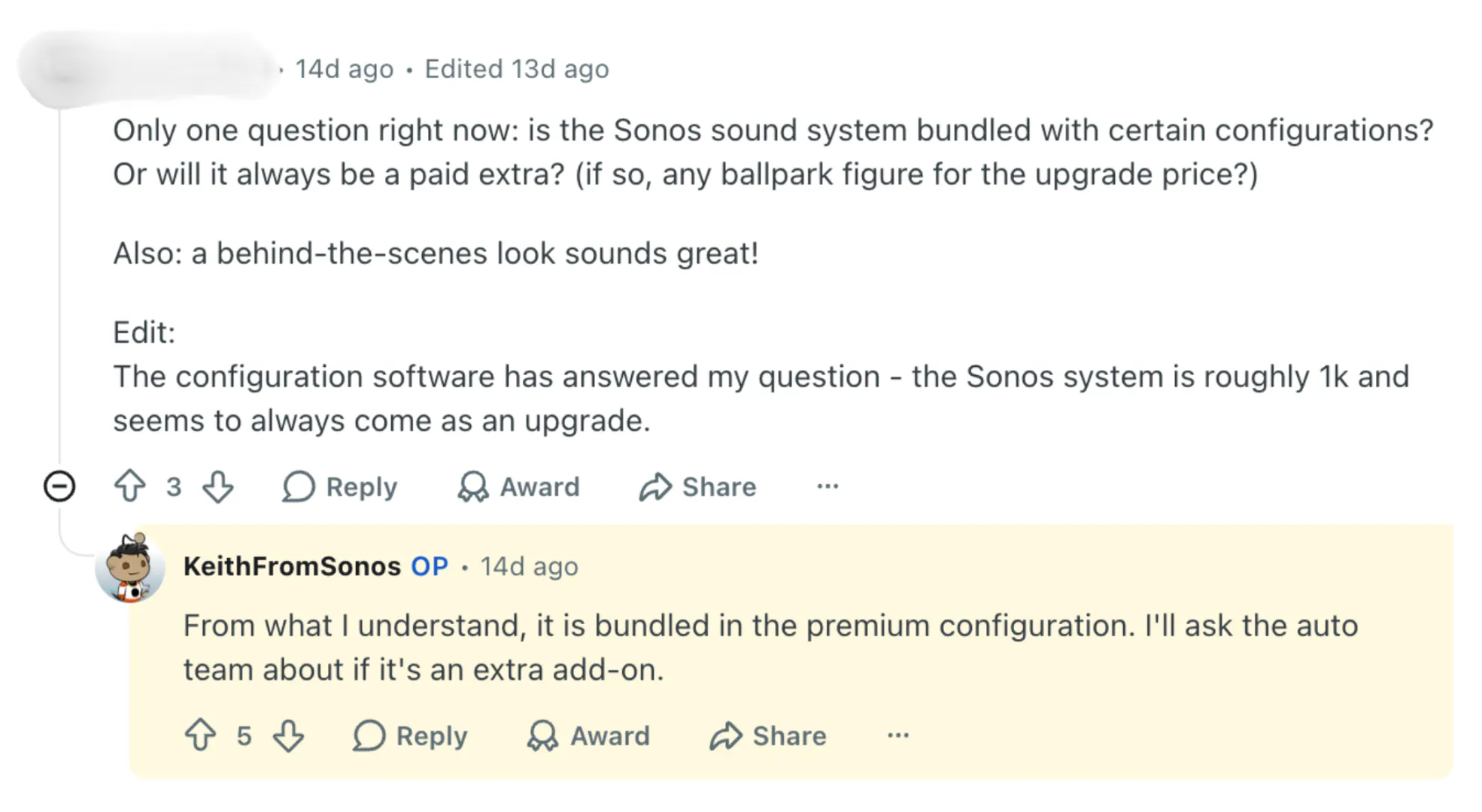
Instead of going quiet, Keith from Sonos jumped into the conversation. As a named employee, he worked with the subreddit's moderators, answered product questions, addressed complaints, and posted updates on what the company was fixing.
The message was, in Casey’s telling, was quite simple:
"We heard you, we heard the feedback, we're working on it.”
The subreddit subsequently became "a really active source of customer engagement, education, and advocacy."
Two-way conversation builds that trust, and the same rule carries into paid work on the platform. Casey's guidance is to be transparent about being a brand and to "act like a human on the platform."
Keith showed up fast, and the trust he started building kept paying off long after. The window most teams get to prove results closes well before that.
Faster tools, shorter patience
Validation changed how shoppers buy, and marketers speed to keep up. More technology, shorter cycles, faster reads on whether something is working. That speed helps a brand answer a thread the same day, but Casey watches that short window come with a cost.
Budgets tighten, businesses get risk-averse, and every dollar has to prove itself by quarter's end. Casey sees what gets squeezed first.
"There's a lack of patience for innovation. If something doesn't work once, we're [marketers] ready to walk away."
A new channel gets the same two-week window as a retargeting tweak. Two weeks can tell a team whether the ads delivered, but a considered purchase can take months, so the test ends long before the buyer even gets to decide. .
"We're losing the human element of iteration cycles that is longer than the robot."
We’ve seen the same two-week window cut creative and awareness work, where the payoff shows up long after the quarter closes. Relevance is a long-term investment, and nobody can hand a VP a certificate saying the brand will still matter in 20 years. Work that cannot show a receipt by the end of the quarter tends to get cut first, and a longer time window gives it a fairer read. A revenue forecast from the Care Index gives that work a number to bring to the CFO.
Where trust gets settled now
Twenty years in, Casey says the argument has not moved.
"As advanced as we have become, the questions that we're solving for are the same."
Art against science. Quality against quantity. Brand against bottom line.
What did move is where trust gets settled. Word of mouth has always been marketing's most trusted source, and it now has a new home: in a conversation between people who will never meet. That piece of the customer journey will always be there, whether a plan accounts for it or not. The brands that fund it, give it more than two weeks, and show up as humans will hold a piece of the journey no impression can buy.
The models will keep getting better at the answer, but people will keep adding one word to the end of their search: reddit. That word, as we see it, is the part no model has replaced.