Charles Melcher studies what makes immersive experiences work. Giant Spoon and HBO's Westworld activation is one of the examples he uses to prove his point.
Season two of Westworld wrapped in June 2018 after an 18-month gap since the show's debut. After a 18-month Westworld hiatus, HBO faced a re-engagement problem: how do you remind the world this show exists without blowing the budget on scattered TV spots and digital ads?
HBO bet the majority of their Westworld season marketing budget on a single three-day activation at SXSW—and partnered with Giant Spoon to build it. We recreated Sweetwater, complete with 66 actors and a 444-page script. 4,500 attendees generated 1.9 billion social impressions.
That's 422,222 impressions per person. No TV buy produces that multiplier.
Seven years later, it remains one of the strongest examples Charles Melcher, founder of Future of Storytelling, uses to explain where the whole industry is headed. After spending 30+ years watching entertainment companies build deep audience relationships (and watching most brands settle for surface-level reach), he knows what immersive experiences can actually accomplish: "Somebody walks in, we're counting it as one set of eyeballs, and yet they've walked out telling everyone, sharing it like crazy on social media, and talking about it for years."
Melcher's three-dimensional scoring system predicts which immersive concepts will deliver exponential earned reach, and which will burn budget.
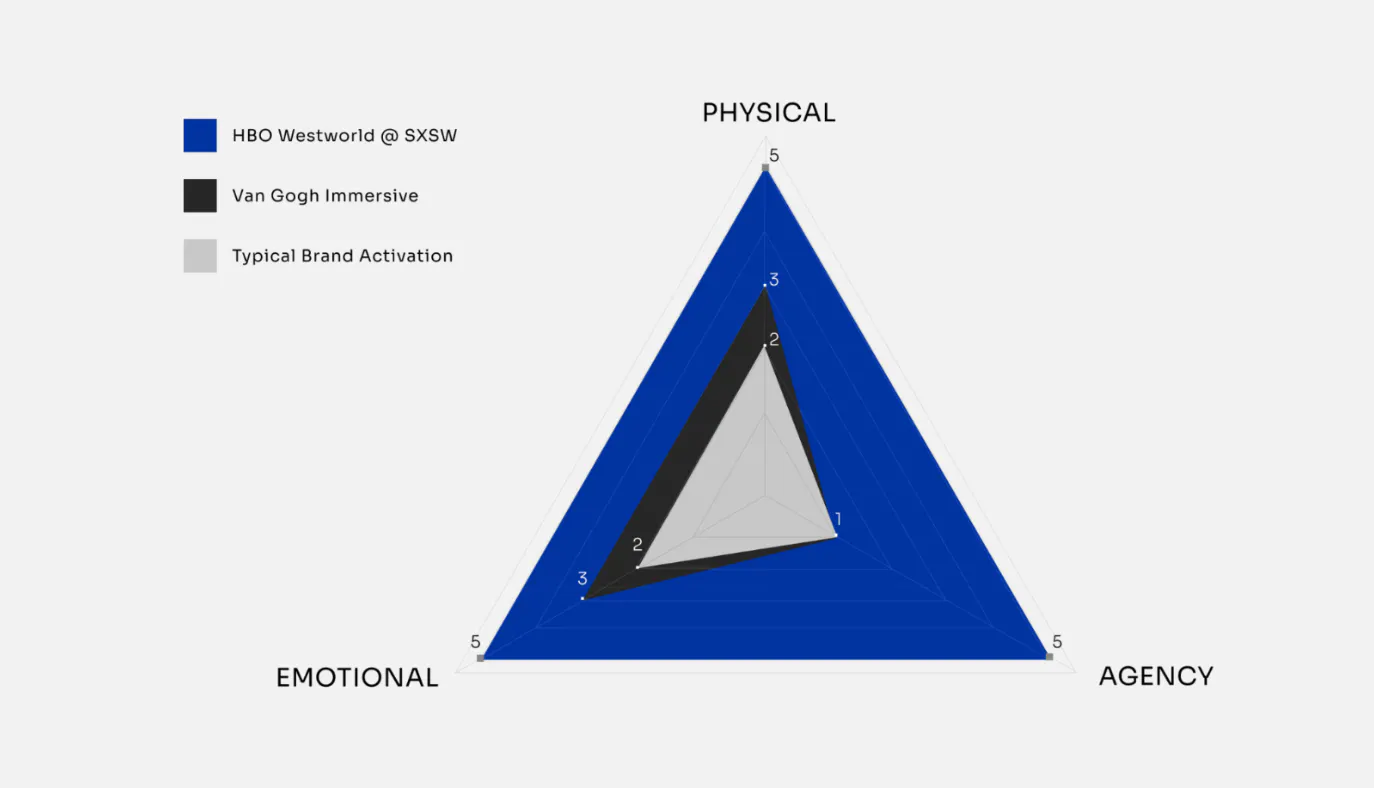
See how we scored with Westworld.
Key Takeaways
- HBO's Westworld activation reached 4,500 people but generated 1.9 billion impressions—422,222 per attendee through organic amplification, not paid media.
- Melcher's three-dimensional scoring system evaluates immersive concepts across physical immersion, emotional stakes, and level of agency afforded to participants (i.e., how much they can affect the narrative and its outcomes)
- Concentrated immersive experiences outperform scattered impressions for subscription brands—each transformed attendee becomes an evangelist multiplying reach exponentially.
Immersive without metrics is just expensive
Marketing leaders commission immersive activations with vague mandates: make it memorable, make it immersive. Creative teams return with expensive production plans. Finance questions the ROI. Everyone argues because "immersive" means nothing measurable.
Melcher's scoring system turns subjective creative assessment into objective evaluation. Three independent dimensions—physical immersion, emotional immersion, and agency—are each scored on a five-point scale:
- Physical immersion: True physical immersion is a multisensory experience that goes far beyond sight and sound. So, how fully is the body engaged?
- Emotional immersion: Does the experience create stakes, surprise, possibility of failure?
- Agency: Can participants make meaningful choices that affect outcomes?
"Immersive Van Gogh" projection experiences—where Van Gogh paintings animate across walls and floors in warehouse spaces—score low on both physical and emotional immersion. Visitors walk through and observe; the work fills your field of vision, but nothing engages your body or your other senses. Score them a 2 on physical, a 2 on emotional, and close to zero on agency. Amazon's Alexa escape room at New York Comic-Con scored high across all three—physical engagement, emotional stakes, real agency using voice commands to unlock story progression and solve puzzles.
The system solves three problems:
- Comparing incomparable concepts that would otherwise be impossible to evaluate against each other—a passive walkthrough vs. a branching narrative vs. a fully embodied experience all land somewhere on the same axes, for example
- Articulating specific design goals ("we need a 4 on agency, 3 on physical" instead of "make it engaging")
- Benchmarking against category leaders to position work in white space.
Melcher imagines objective scoring becoming standard. Teams that adopt three-dimensional evaluation before production avoid expensive creative misdirection. The system catches concepts that look impressive in pitch decks but score low on dimensions that drive social amplification.
Building Westworld at SXSW
Traditional media planning optimizes for maximum reach at lowest cost-per-thousand. HBO's Westworld activation inverted that logic by investing almost the entire season budget in a single concentrated experience at SXSW that we designed and executed.
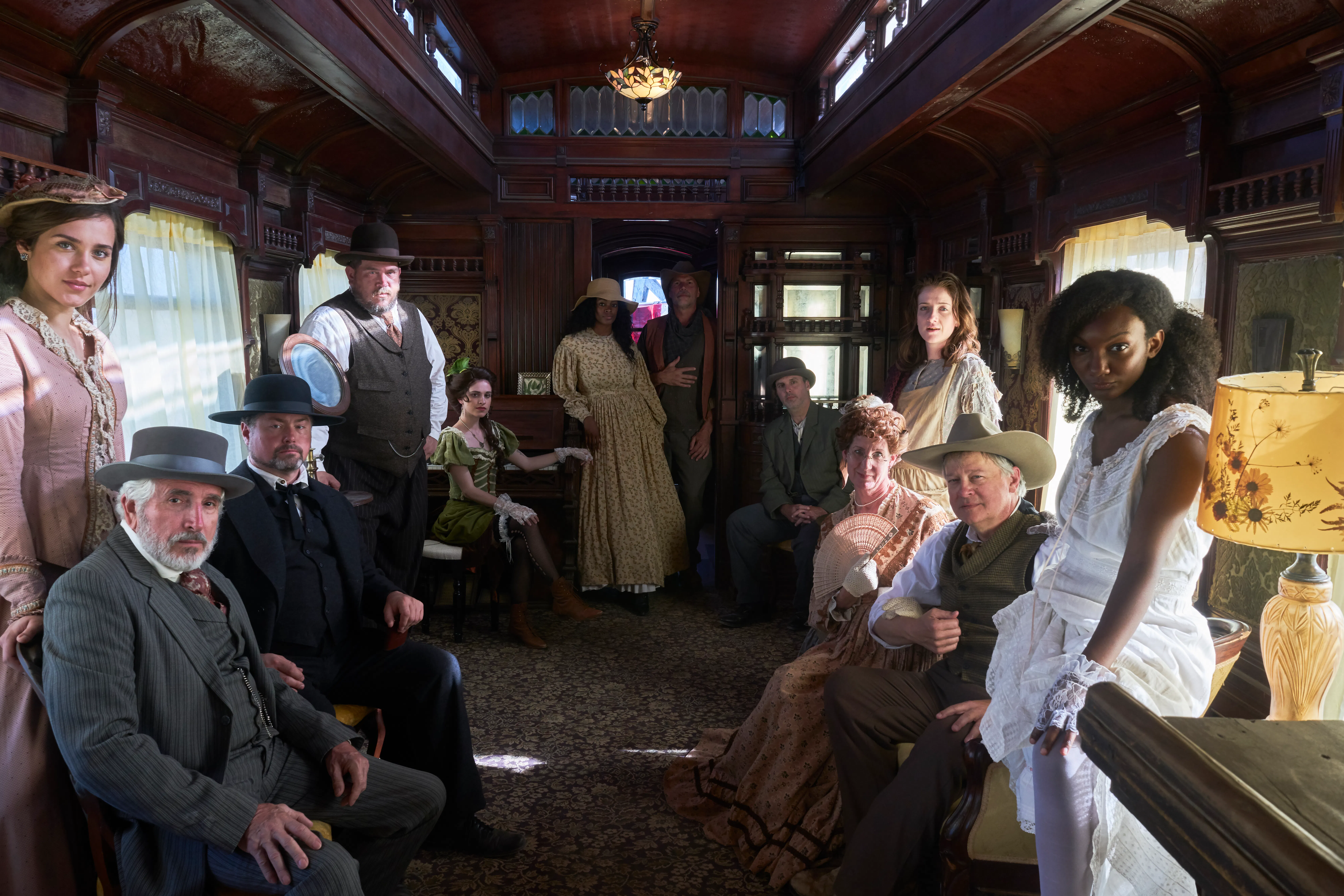
Giant Spoon recreated the show's Sweetwater town across 90,000 square feet with 66 actors over three days. Guests arriving by train stepped into multiple diverging storylines—encountering the blacksmith, receiving mysterious letters at the post office, embarking on adventures with dozens of potential outcomes.
The results:
- 4,500 attendees over 3 days
- 1.9 billion social media impressions generated
- 422,222 impressions per attendee—a multiplier impossible with passive content
- Nearly 500 articles published globally through attendee evangelism, not paid amplification
- Forbes declared it "certain to inspire FOMO and regret for years to come"
- Vanity Fair said it "transported fans into their favorite show in a way no high-tech VR experience ever could"
- Axios called it something that "transcended the entire city"
- A.V. Club named it one of the best publicity stunts of the 21st century
Melcher also included our Westworld experience in his book, The Future of Storytelling: How Immersive Experiences Are Transforming Our World, as a benchmark for what concentrated immersive storytelling can accomplish. To this day, he considers it one of the strongest proof points for the power and impact of immersive brand activations.
Westworld proved that intimate, high-stakes experiences can generate more business value than casting a wider net. Each participant became an evangelist. HBO couldn't rely on traditional advertising revenue since their model is subscription-based. They measured success by cultural conversation. "The success of the Westworld experience at SXSW was really in the shared social stories and the earned media that came off of that,” Melcher adds, acknowledging the underlying business impact of the activation.
Three forces changing how brands buy media
Media companies lead because they understand IP value grows when fans physically enter story worlds. Just look at Netflix Houses opening globally, the continued global expansion of Disney parks, and HBO betting season budgets on high-scoring activations. Entertainment companies already understand immersive experiences aren't marketing expenses, but revenue diversification.
Most still treat experiential as expensive reach plays rather than recognizing it as an emerging dominant medium. Melcher makes a contrarian prediction.
"I'm a thousand percent convinced that this type of storytelling will be a bigger business than Hollywood or gaming because it is that much more powerful."
He’s already seen three forces accelerate this trend:
- Business models proving out: ABBA Voyage, a concert with CGI performers, is running profitably, selling 3,000 seats nightly. Sleep No More operated for over a decade. Each proof point validates that immersive experiences can scale profitably beyond one-off activations.
- Audiences training themselves: Every escape room participant, every interactive museum visitor trains themselves to expect higher participation. "There is a dance taking place between the creators figuring out how to use all these new tools, business models figuring out how it works financially, and then for the audience to get comfortable getting out of their seats."
- Infrastructure building: Entertainment companies are building permanent facilities brands can leverage without building from scratch.
The metric shift: Traditional media buying optimizes cost-per-thousand-impressions. Westworld demonstrates an alternative metric with “cost-per-transformed-advocate.” How much does it cost to create one person who generates 422,222 impressions through organic amplification?
Westworld's math is hard to argue with: budget spent reached 4,500 people who generated 1.9 billion impressions through their own stories instead of paid placement. For subscription businesses and high-consideration categories, that multiplier matters more than raw reach. The goal post moved from counting eyeballs to something more meaningful: creating experiences so powerful that people can't stop talking about them.
Strategic questions for 2026 planning:
- Which customer segment delivers disproportionate lifetime value—and what would it look like to concentrate your budget there rather than spreading it across your full audience?
- What would your customers need to experience to walk out feeling like a different version of themselves—and want to tell everyone about it?
- How do our concepts score using Melcher’s three-dimensional scale of immersion?
We're not just witnessing experiential marketing maturing as a tactic, but rather a new dominant medium being born—one that will restructure how brands allocate budgets, measure success, and build relationships.
Entertainment companies see it. A few early-mover brands are testing concentration models. Most are still optimizing last decade's playbook.