Consumer behavior, The Care Index ™, and the brands already investing in their next decade
Good news: your media plan is working.
Bad news: it's working so well it's running out of people to work on.
We've watched this moment arrive for enough brands to recognize the pattern—results look fine on paper, conversion rates hold, and then, quietly, new customer growth stalls. Nobody in the room has a clean answer for why.
Janna Navarro, VP Managing Director at Wpromote x Giant Spoon, built her career diagnosing exactly this problem. After nearly 20 years solving this problem across agency and brand side, she joined Wpromote to lead a harder conversation:
What do you do when performance has been optimized so well that it stops growing?
"Performance media captures who's ready to buy now," she says. "Brand media builds who will be ready later." Turns out, measuring the gap between the two is where growth actually lives.
Key Takeaways
- Performance media captures who's ready to buy now. Brand media builds the pool of who will be ready later.
- A delivered impression and a meaningful one are not the same thing. Context, creative, and placement determine whether contact actually registers.
- Consumer-led measurement turns brand equity into a revenue argument—one that holds up in a CFO meeting.
What good metrics miss
The performance plateau creeps up.
It builds over years of lower-funnel investment that's working perfectly by every metric that's easy to track—and doing nothing for consumers who aren't ready to buy yet. By the time new customer acquisition shows the damage, the upper funnel has been starving for 18 months or more.
We've seen this repeat across clients who came in with strong conversion numbers and no explanation for why growth had stalled. Performance media is optimized for a specific, narrow window of consumer behavior. Everything outside that window, which is most of your potential market, goes untouched.
"What brands are starting to see is they're losing momentum in terms of new customer acquisition,” Navarro explains. “They know they need it, but it's asking: ’how do I do it? I've gotten so addicted to immediacy.’”
According to WARC's 2025 Multiplier Effect report, brands that shift from a performance-only media mix to a balanced one can improve total revenue ROI by 25% to 100%. The gap between knowing this and knowing what to actually do about it is where most brands sit.
The 5% ceiling
At any given moment, roughly 5% of a brand's market is actively in-buy mode. Performance media was built for them and it excels. The issue is what happens to the other 95%: consumers who will buy in six months, a year, sometimes longer.
In high-consideration categories like automotive, brand preference forms well before anyone starts shopping. A conversion ad reaching someone already leaning toward a competitor doesn't change the outcome. The window to influence them closed long before that ad served.
"If you're always hitting the 5% of customers that are willing to buy you now, you're forgetting the 95% of customers that are going to buy you tomorrow, next month, even a year from now."
Not all impressions count
Volume optimizes for reach, but brand media has to optimize for quality of contact.
Navarro says:
"Not all impressions are equal”
A meaningful impression—where context, creative, and placement all come together—does something a delivered impression can’t: it moves a consumer who wasn’t ready to buy yet.
Most tools weren’t built to measure that difference. So Navarro helped build one.
Introducing The Care Index ™
Co-developed with Northwestern-Medill University’s MBA program, and validated across 100 brands in 22 categories, The Care Index ™ is that tool.
Most brand health tools measure what companies put out: awareness scores, share of voice, NPS. The Care Index ™ measures how consumers actually respond. Every one of its 16 inputs is consumer-led, not brand-directed. "I felt really passionate about keeping it clean," Navarro says. "It's how consumers view you as a brand, not what you can control."
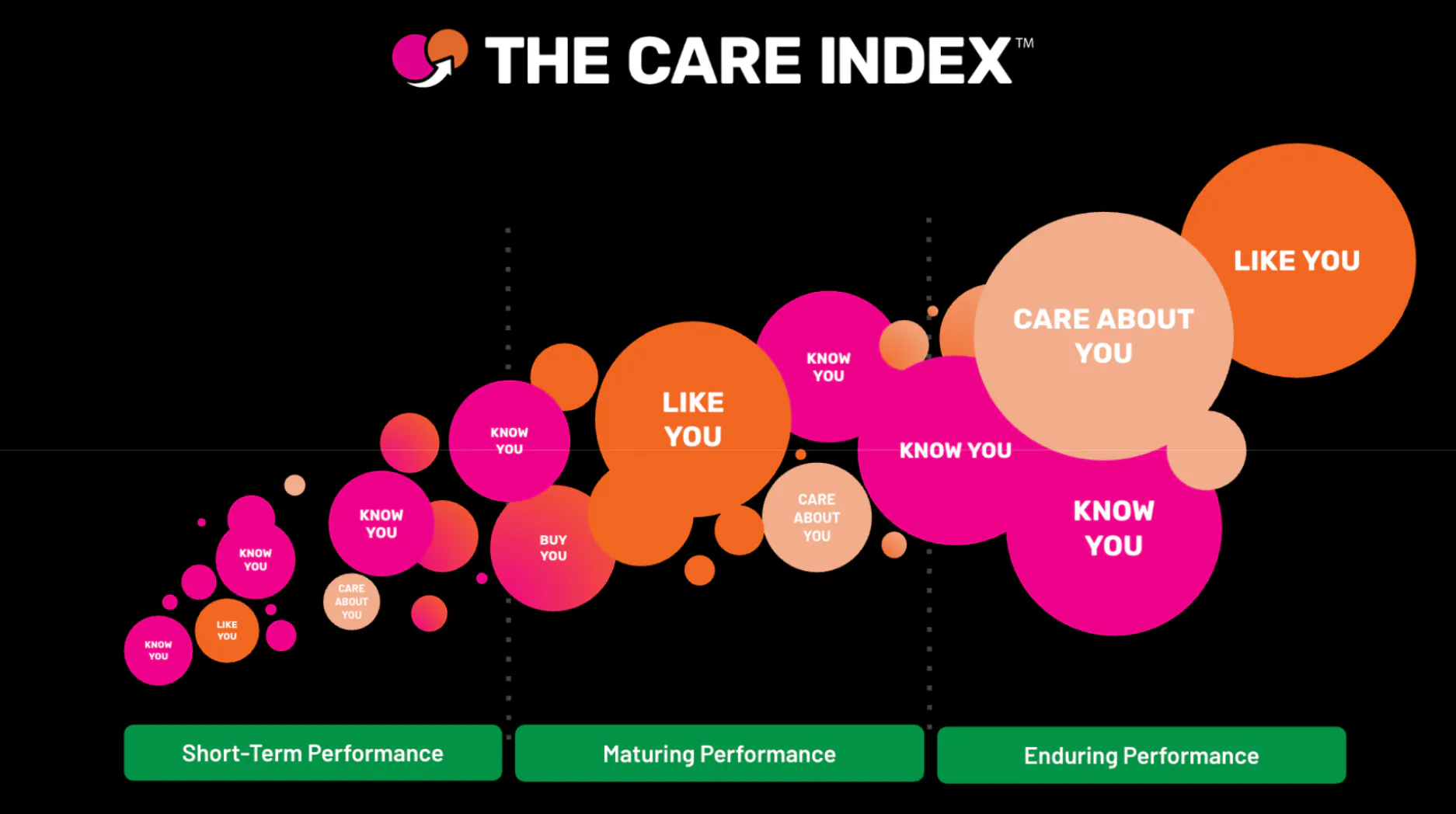
The index tracks where consumers sit in their relationship with a brand—whether they know it, like it, or genuinely care about it.
“Care" is the deliberate target, while “brand love” is aspirational but rare.
"There are probably two or three brands any given consumer actually loves," Navarro explains. "But there's 50 brands they care about that are still worth recommending, still worth buying again."
The score connects to a revenue projection: raise your care score by a specific number of points, and the index produces a corresponding revenue figure. That's the slide that reframes a brand investment into a financial projection. "Having the numbers, the dollars attached to it becomes really powerful."
Score position also drives where media dollars go:
- High awareness, low care → social content, influencers, community-building, and buzz-worthy culture moments
- High care, low awareness → reach-based media